

Searching for Gallo Grande

Saltwater fly fishing encompasses many biomes and environments, not just constrained to the shallow flats of tropical countries. It can take you into the cold surf of the Oregon Coast for surf perch or blind casting off the beaches of Gabon for the world's largest tarpon. This time, the saltwater itch is taking me to the blue water of the Sea of Cortez, in search of primarily roosterfish, but mahi mahi, tuna, or just about anything that will eat a fly is on the table.
Baja Sur is a relatively easy place to access with a low cost of entry compared to some of the more remote saltwater destinations scattered among the island nations of the world. Cabo is only a couple of hours away, so you know there are plenty of flights arriving daily from everywhere in the world. But Cabo is not my final destination; instead, it will be the small town of El Sargento, situated on the Gulf of California.
As saltwater environments change, so do your tactics, gear, and presentation. No longer will crabs, shrimp, and other small flies be the mainstay in the fly box. Instead, baitfish patterns are the main fodder for roosters and jacks that hunt down schools of bait. Rods, reels, and lines change too, bigger rods for large, wind-resistant flies. I'll go over the gear and information I garnered to target roosterfish in Baja, Mexico.

Gear for Roosterfish
Saltwater fly fishing takes up such a small portion of my time on the water, which makes it difficult to empty the pocketbook for the latest and greatest gear. I don't necessarily use the nicest rods and reels for any of my fishing, and ultimately, the high-priced stuff never helps you catch more fish.
But when going to a new destination in search of different species, you need to get the gear that helps you catch fish. For this trip, new reels, lines, and rods are needed (somewhat). Some setups will make the transition to this style of fishing, such as my 11wt setup, because it has ample backing capacity and an intermediate line, but ultimately, some aspects of my saltwater setups need to be changed.

Rods and Reels
Rods and reels are two of the most important pieces of saltwater fly fishing. The rod needs to be adequately scaled to the size of the fish and the size of the fly. 10-12 weight rods are recommended for roosterfish, whereas 8-9 weights are adequate for small roosters and other species.
Two of the three rods for the trip were new to me but not fresh off the press; they are older models from the last few decades that I found on Facebook Marketplace or such. Used gear swaps, Craigslist, and FB Marketplace are great resources to find used gear for a great price. Get last year's latest and greatest for a fraction of the original price.
10 wt Winston Boron II
This rod ended up being the stick I enjoyed waving around the most during my 6 days of fishing. This rod is light in hand, has a moderate flex, and is just an enjoyable rod to cast all day long. This pre-2010 rod performed beautifully, fighting roosters and jacks in the Sea of Cortez, and was a good reminder that rod technology is mostly marketing. I prefer a rod with feel, a good bend when it loads on the backcast, which are usually more forgiving to a caster as well. This rod checked that box easily and will definitely be a mainstay in the quiver going forward.
11 wt Lamson Cobalt
The Lamson Cobalt is easily one of the best value saltwater fly rods on the market, coming in a $500. The action is smooth and powerful, offering a good amount of feel without sacrificing distance. Lamson is mostly known for their reels, but I am impressed by their rods and plan to add more into the rotation in the future. I used this rod the least because it was paired with the RIO Intermediate Flats Pro line, which did not work well for me in this fishing scenario. The reason is in the name; it's designed to throw long distances with precision accuracy with flats-sized flies (shrimp, crabs, small baitfish, tarpon toads), all of which don't offer a large amount of wind resistance. The longer head of this line didn't have the turnover power needed to throw the 6+ inch baitfish consistently unless I was perfect on every cast. It felt like work casting this rod, so I quickly set it down.
12 wt Sage RPLX
The Sage RPLX is from the 80s and 90s, but still catching fish in 2026 (Thanks, Scott). This rod fished well, and I really enjoyed the upper fish-fighting grip that gave the angler some extra leverage above the casting cork. This rod is well known for being extremely fast and stout, which I noticed immediately. It handled the roosters and jacks easily, although it never got a test against an XL roosterfish. Casting the RPLX is a stark contrast to my 10wt Winston. The RPLX is all power, and it can be difficult to feel the rod load. Although when my timing was on, I shot the entire fly line easily. In the future, I would consider overlining the rod to a 13 if I can find a suitable line, but fly lines become highly specialised beyond 12 weight, geared towards large pelagic species like marlin and sailfish.
Lines
Rio Outbound Short Tropical Intermediate
This is the line you need for fishing Baja, or something comparable in another brand, as the short, powerful head easily turns over large flies and shoots line extremely well. The one issue I have with this line is that the running line likes to tie itself up, usually when the biggest roosters are crashing bait near the boat, but no line is perfect. Take extra care where you place your fly line on the deck of the boat, and make sure to cast a few times to stretch the line out before you start to cast towards fish.
Rio Flats Pro Intermediate
While this is a great line to take to Belize, Mexico, or anywhere you need a full intermediate for tarpon or other flats species, this line felt undergunned for the rapid-fire casting for roosterfish. The roosterfish are predators and never stop moving. Being able to pick up the head and easily shoot out most of the line is a huge plus in my book because it saves your arm and allows your flies to spend the most time possible in the water.
Flies
Rooster fish eat mullet, sardines, blue runners, and needle fish. These are schooling baitfish, and the roosters create an electric display when they come to the surface chasing the smaller fish. Pack a variety of colors and sizes to help fool these intelligent fish. They are adept at rejecting flies, and it's a heartbreaking feeling watching a 50-pound rooster sniff your fly before flying off after the real thing.
Brown, tan, and grey were the most productive colors to mimic the sardines, but the fishery changes throughout the year, and it pays to be well stocked on flies. Additionally, the needle fish will cut your leader, so bring multiples of the same pattern.
Tippet and Other Odds and Ends
When fishing for roosters, use 20-30-pound leaders. Our guides preferred a straight 30-pound piece of tippet from the line to the fly, but I also tied some of my own leaders with a 50-pound butt section tapered to 20-pound or 30-pound tippet. For the big roosters, 30-pound leaders will give you the extra security to fight the fish.
A strong pair of nippers to cut heavy monofilament and a heavy duty pair of pliers to deal with toothy fish are great additions.
The Fishing
There are a variety of methods to fly fish for roosters. Some anglers run the beach, utilizing ATVs and sand sprints to chase roosterfish crashing the bait on the beach, whereas anglers fishing from a boat throw bait or use a popper on a spinning rod to bring the roosterfish within casting distance. We fished from the boat and primarily used bait to attract the roosters (and hordes of needle fish), which seemed to be the most popular practice around El Sargento. We fished with Juan Lucero Fly Fishing, a local family-focused guide service. They were great people to fish with, and I would recommend them to anyone looking to fish in the area.
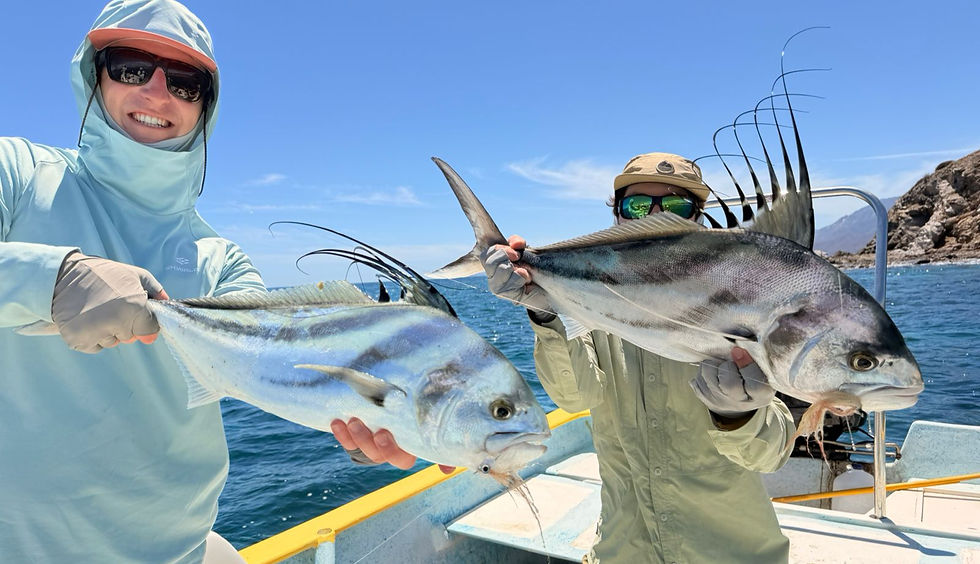
April is the beginning of the best roosterfishing, and we arrived right as the fishing was heating up for the season. We started the day around 7 am and immediately went to an island where the bait fisherman threw cast nets for sardines. Over the course of the trip, we revisited many of the same spots, and as with any guides, we all have zones where our confidence in catching fish inflates. After running for bait, we headed for spots that usually hold larger roosterfish, which are impressive specimens, especially compared to the juveniles. The roosters surfacing for bait or cruising under the boat resemble submarines with spines. But they were wily and would ignore the bait being thrown and stay deep below the surface.
How to Prepare: Practice, Visualize, Slow Down
The casting in Baja was different than Belize or any other fishing I've done. The roosters never stop moving and are constantly redirecting to find another sardine, so it becomes quite a challenge to anticipate the next move and place a fly on the dinner plate. This causes you to feel rushed, which makes for poor casting and ineffectual fishing, which is why I recommend slowing down, even if the guide is yelling for a cast or the fish are close to the boat. Make sure the line is organized, the fly is placed at the right distance to feed the fish, and the two-handed strip keeps the fly moving.
The high-paced fishing to crashing roosters will make any angler want to cast until their arm falls off. Instead, pick your moments carefully once you recognize the moments with the best chance at a hookup, because every second the fly is in the water, not being chased by a rooster, a needlefish is eager to abrade the leader or take your fly.
Practice shooting line on one or two false casts. This will not only get the fly to the fish quicker, but also save energy. A double haul is a great tool to generate line speed to punch against the wind and deliver the wind-resistant flies.
The two-handed retrieve takes practice to get proficient, but it is an important tactic to keep the fly constantly moving like a real sardine fleeing. Strip the fly close to the boat when the roosterfish are in a frenzy. I caught multiple roosterfish next to the boat, right as I lifted my rod to cast, which made for an awkward hookset that looked a lot like a trout set, but still managed to stick the fish.

Suave Rapido: Execute Even When the Adrenaline is Pumping
The excitement of fishing can do the most harm to the execution of the cast and fly retrieval. Amped up anglers rush their cast, fumble the line, and tense up when the fish are close. I see it all the time while guiding when anglers cast to a rising fish; the excitement takes over, which leads to a rushed execution of the first cast. I've experienced it too, especially in saltwater scenarios when the window of opportunity is small, and a perfect cast is needed. I remember my first two casts on the flats in Belize. Two tarpon cruised in front of the boat, the guides were loudly urging me to get the fly to the fish as soon as I jumped up front, and I tried to strip line off the reel while casting the fly, thus ending with the fly in the guide's sunshirt, not once but twice. Not an ideal situation, and tough warm-up, but in saltwater fishing, perfect execution after extended periods of inactivity is the name of the game.
Fly fishing in Baja is different, but similar principles apply. The fish are more localized; they don't disappear after a quick drive by, leading to a single shot. Usually, they stayed close to the bait before slashing through the school for another morsel. This means the angler can take a breath and prepare for another opportunity. Suave rapido is something my baseball coach used to say, smooth is fast, and this applies to everything from a golf swing to a fly cast. There is no power without timing, and when the timing is correct a fly cast looks effortless.
Baja is a great introduction to saltwater fishing as the fishing is action packed, there are a variety of species to catch; from skipjack, mahi mahi, roosterfish, and jacks. The big roosters are not easy to catch but worth the reward.
Other than the Fishing
The town of La Ventana/El Sargento is small and a very relaxing place with good beaches, restaurants, and friendly people. There are a variety of other activities to pursue other than fishing, like wind sports, whale watching, jet skiing, snorkeling, and scuba diving.
The food was delicious and the margaritas were fresh, and it felt like a place I would go back to again and again, for more than just the fishing. The fishing days are shorter than I was used to, around 6 hours, which left plenty of time to grab a late lunch, enjoy the beach, or take a nap after a hot day of fishing.
I look forward to the next visit to Baja and if you have any questions or interest in visiting and want to talk about it, shoot me a text or email.


Comments